Precision Manufacturing: Automated Mesh Pocket Cutting for Custom EVA Cases
Automated thermal mesh cutting uses temperature-controlled hot blades to trim and heat-seal the edges of internal storage pockets simultaneously. Unlike manual scissor cutting, which often leaves frayed edges and dimensional variations, automated thermal cutting guarantees 100% size consistency, zero thread fraying, and clean seam integration for custom EVA protective cases. LeaderCases utilizes automated thermal cutting across high-volume OEM/ODM production runs, delivering daily capacities up to 4,000 units.
When sourcing custom protective packaging, procurement managers often focus on the outer shell and main zippers. However, the internal organization—specifically the lid mesh pockets designed for charging cables, user manuals, and small tools—is equally critical for end-user satisfaction.
Why Is Automated Mesh Pocket Cutting Essential for Custom EVA Cases?
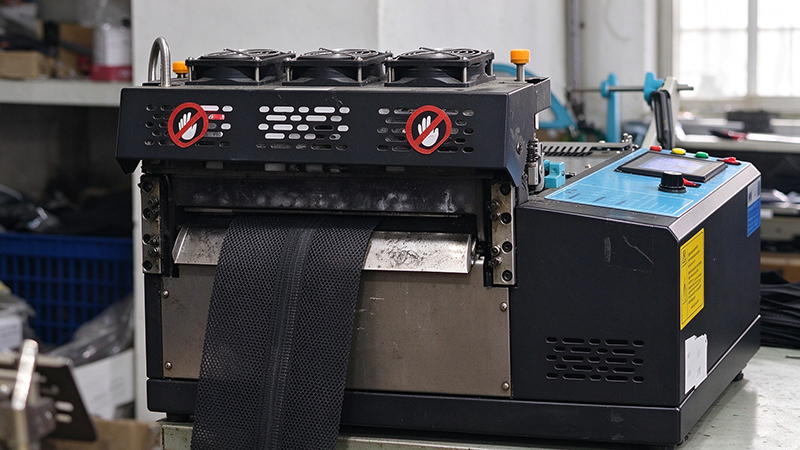
Automated thermal mesh pocket cutting prevents edge fraying, guarantees strict dimensional accuracy, and eliminates structural failure in internal case compartments. In custom EVA case manufacturing, internal mesh pockets hold essential accessories like charging cables, medical probes, power adapters, and instruction manuals.
Manual cutting with traditional shears or cold die-cutters creates weak fabric edges that unravel under continuous elastic tension. Thermal automated cutting utilizes temperature-controlled blades that instantly cauterize synthetic mesh polymers (nylon/polyester) during the slicing process, permanently sealing the fiber ends.
Fray-Proof Edge Sealing: Thermal melting fuses synthetic yarns at the cut border, preventing loose threads during heavy daily usage.
Millimeter-Level Tolerances: CNC automated feeding maintains dimensional tolerances within ±0.5 mm, ensuring every mesh pocket aligns perfectly with pre-molded case lids.
Scalable Production Throughput: Automated cutting systems process up to 1,200 mesh panels per hour, supporting high-volume OEM orders without production bottlenecks.
Manual Cutting vs. Automated Thermal Mesh Cutting
The choice between manual and automated mesh preparation directly impacts component durability, cosmetic quality, and overall assembly speed. The table below details the performance parameters between the two manufacturing methods:
| Manufacturing Parameter | Traditional Manual Cutting | Automated Thermal Cutting (LeaderCases) |
|---|---|---|
| Cutting Mechanism | Mechanical Cold Shears | CNC Temperature-Controlled Hot Blade |
| Edge Finish Quality | Open fibers, highly susceptible to fraying | Thermally sealed, fray-proof edge bead |
| Dimensional Tolerance | ±2.0 mm to ±3.0 mm | ±0.5 mm (CNC Precision Feed) |
| Tensile Fatigue Resistance | Low (seams degrade under elastic pull) | High (fused edges prevent thread migration) |
| Production Capacity | Approx. 150–200 pcs/hour/operator | Up to 1,200 pcs/hour/machine |
| Material Compatibility | Limited to standard non-fraying fabrics | Polyester mesh, 1680D Nylon, elastic webbing |
| Defect Rate (PPM) | > 2,500 PPM | < 100 PPM |
What Fabric Materials Work Best with Automated Thermal Cutters?
Synthetic thermoplastic fabrics—specifically high-density polyester mesh, 1680D nylon backing, and polyurethane-coated textiles—deliver optimal results under thermal cutting. Thermoplastic fibers melt predictably under controlled heat (220°C–280°C) without charring or discoloration.
Recommended Material Combinations:
High-Density Elastic Polyester Mesh: Offers superior stretch recovery for bulky power adapters and diagnostic tools.
1680D / 600D Ballistic Nylon Edging: Provides extreme wear resistance for industrial tool storage.
Velour-Lined Soft Interior Trims: Protects delicate screens and optical lenses from contact scratches.
E-E-A-T & Quality Assurance Standards at LeaderCases
At LeaderCases, precision manufacturing is embedded into every stage of production across our 1,500m² Guangdong facility. With over 15 years of dedicated OEM/ODM export experience, we maintain strict quality control protocols:
100% In-Line Inspection: Automated thermal cut panels undergo continuous optical dimension checks before reaching the sewing line.
Rigorous Stress Testing: Finished cases with integrated mesh pockets undergo 500+ cycle stretch tests and 1.2-meter drop tests to guarantee zero seam separation.
Rapid Prototyping & Sampling: Physical sample lead times range between 5 to 10 days, supported by rapid 3D CAD/foam layout previews before full mold commitment.
Flexible Volume Ordering: Standard production MOQs start at 200–500 pcs per custom design, backed by a daily capacity of 4,000 completed units.
Frequently Asked Questions
A: Physical sample lead time ranges between 5 to 10 business days depending on mold complexity and logo specifications. Digital 3D mockups and interior CAD layouts are provided within 24 to 48 hours for initial approval.
A: Yes, CNC automated cutters can be programmed for specific width, length, and contoured angles. This ensures customized mesh pockets fit specialized lid contours for diagnostic equipment, medical monitors, and drone accessories.
A: Thermal cutting fuses the raw edges of the synthetic fibers so they cannot pull apart under strain. When paired with high-resilience elastic binding bands, the pocket maintains consistent tension even after extended daily use.