Quality Custom EVA Cases Start at the Source: Raw Material & Cutting Process Matters
📌 Quick Answer: Why Does Raw Material & Sheet Cutting Matter in Custom EVA Case Manufacturing?
The durability, shock absorption, and wall consistency of a custom EVA hard case depend heavily on the initial raw material preparation and precision cutting stage. Utilizing high-density virgin EVA sheets (up to 75° Shore C hardness), eco-friendly hot-melt lamination, and automated heated-knife web cutting prevents shell warping, uneven thickness, and material fraying during thermoforming. LeaderCases enforces strict source-level material controls and AQL 2.5 QA standards to ensure 100% batch-to-batch reliability for global OEM clients.
When B2B procurement managers evaluate custom EVA case suppliers, attention often centers on surface branding, zipper smoothness, or interior foam inserts. However, long-term structural durability and protective performance are actually decided long before thermoforming begins—right in the raw material storage and initial sheet cutting workshop.
At LeaderCases, controlling quality from the source is our core engineering principle. By strictly managing raw sheet density, fabric lamination, and precision web cutting, we eliminate hidden structural defects before mass molding.
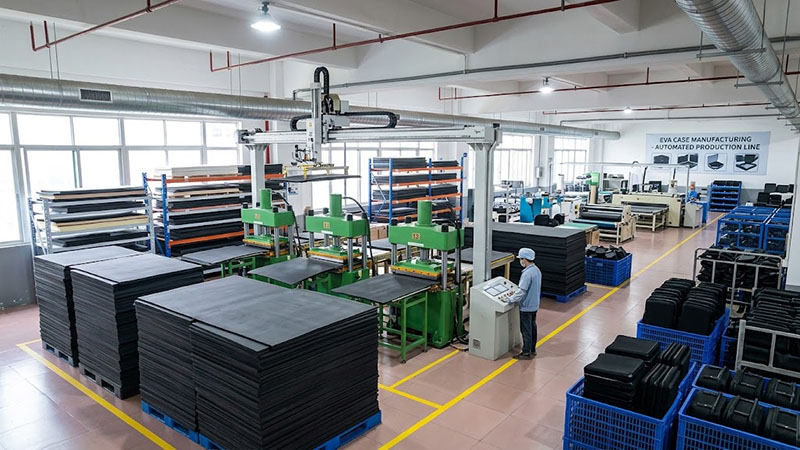
⚙️ 3 Critical Pillars of Source Material Preparation
How Source Precision Drives Final Product Quality:
1. Precise EVA Sheet Hardness & Density Control: We specify virgin 65°–75° Shore C high-density EVA cores. Uniform density ensures maximum impact dispersion, preventing collapsed sidewalls under heavy pressure.
2. Automated Heated-Knife Web Cutting: Traditional cold-stamping die cutters leave jagged edges and dimensional variances. Our automated heated-knife cutting machine seals sheet perimeters cleanly, ensuring exact tolerances for hot-press molds.
3. Eco-Friendly, Odorless Lamination: Outer fabrics (such as 1680D Ballistic Nylon, PU leather, or Oxford) are laminated using certified hot-melt adhesives, guaranteeing REACH/RoHS compliance and zero harsh chemical odors during unboxing.
📊 Low-Cost Factory Prep vs. LeaderCases Source Standards
| Manufacturing Stage | Low-Cost / Budget Supplier | LeaderCases OEM Standard |
|---|---|---|
| Raw Material Storage | Unregulated, humid staging (causes sheet deformation) | Climate-controlled, structured inventory staging |
| Sheet Cutting Process | Manual stamping with high edge variance | Automated heated-knife web cutting machinery |
| EVA Core Density | Recycled, soft 30°–45° foam (susceptible to crushing) | Virgin 65°–75° Shore C rigid shockproof core |
| Adhesive Safety | Solvent-based glues with pungent chemical smells | Odorless, non-toxic eco-friendly hot-melt bonding |
| Quality Assurance | Random visual checks only | 100% material inspection & AQL 2.5 compliance |
🎯 Benefits of Source Control for OEM Procurement
Zero Batch-to-Batch Fluctuation: Precision cutting guarantees consistent wall thickness across thousands of units.
Reduced Lead Times: Organized raw material inventory allows seamless scheduling directly into bulk thermoforming.
Regulatory Compliance: Raw material testing simplifies compliance for REACH, RoHS, and Prop 65 international audits.
Frequently Asked Questions
A: Automated heated-knife web cutting seals sheet edges instantly, preventing fabric fraying and dimensional deformation during the high-temperature thermoforming process.
A: For optimal shock absorption and structural compression resistance, a 75° Shore C hardness rating is standard for electronics, medical gear, and optical cases.
A: We exclusively use eco-friendly hot-melt adhesives rather than low-cost solvent glues during sheet lamination, eliminating chemical odors during customer unboxing.