From AI Renders to Real Cases: What AI Gets Wrong | LeaderCases
📌 Quick Answer: How Does AI Impact Custom Packaging Design and Manufacturing?
Generative AI accelerates early-stage packaging ideation by letting buyers visualize custom bags and EVA cases without CAD skills. However, AI renders ignore material physics, production complexity, and product-protection risks—such as fabrics that snag delicate gear or minimalist seams that require high-defect manual assembly. A mature OEM/ODM manufacturer bridges this gap by translating AI concepts into manufacturable specifications with validated materials, realistic tooling budgets, and rapid 5–10 day physical prototyping.
Over the past year, a noticeable shift has occurred in B2B custom packaging inquiries. Previously, brand buyers and procurement teams approached factories with 2D technical drawings, 3D CAD files, or physical reference samples. Today, an increasing share of inquiries begins with an AI-generated concept image.
At LeaderCases, both our engineering team and our international clients use AI visualization tools during early discussions. While generative AI lowers the barrier to visual communication, translating a polished AI render into a mass-producible protective case requires deep manufacturing expertise.
🚀 How Does AI Help Custom Case & Bag Sourcing?
AI accelerates early alignment by replacing complex CAD drafting with instant visual prototypes that clarify aesthetic direction in minutes. For buyers who are not packaging specialists, describing shell contours, zipper placements, or pocket layouts in text often leads to misunderstandings. Generative AI solves three immediate bottlenecks:
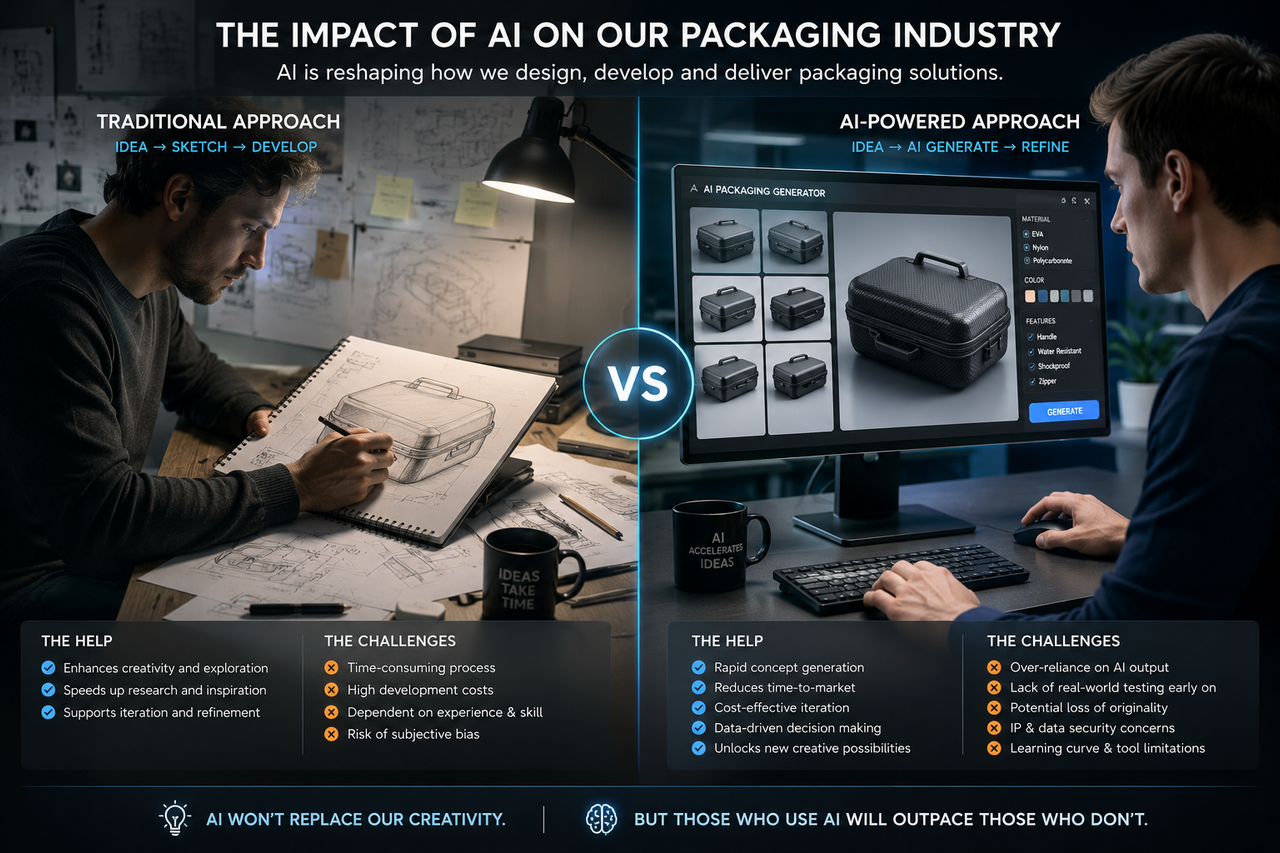
Traditional sketching vs. AI-assisted concept generation: faster visual alignment comes with distinct engineering trade-offs.
Zero-CAD Concept Validation: Product managers can generate realistic exterior styling, color-blocking, and branding placements without hiring an industrial designer upfront.
Faster Buyer-Supplier Alignment: Visual references eliminate guesswork during initial RFQ discussions, allowing our engineers to immediately see the intended silhouette and user scenario.
Rapid Internal Pitching: Sourcing teams can preview approximate final aesthetics to secure internal stakeholder approval before investing in physical mold tooling.
⚠️ Why Do AI-Generated Packaging Designs Often Fail in Production?
AI algorithms optimize for visual appeal rather than material physics, product safety, or factory assembly efficiency. Because image models do not understand fabric tear strength, thermoforming draft angles, or sewing machine tolerances, unverified AI designs frequently create severe functional and financial risks:
1. Hidden Damage Risks to the Stored Product
The primary purpose of custom packaging is protection—if a case damages its contents, the design fails its core mission. In one recent fly-fishing tackle bag project, a client shared an AI-generated interior concept featuring a plush, looped fleece lining for storing fishing flies. While visually cozy in the render, looped fleece is a functional disaster in real-world use: sharp barbed hooks immediately snag and tear the fabric loops, ruining both the bag interior and the angler's flies. Our engineers replaced the looped pile with closed-cell, high-density slotted foam and smooth, snag-free lining.
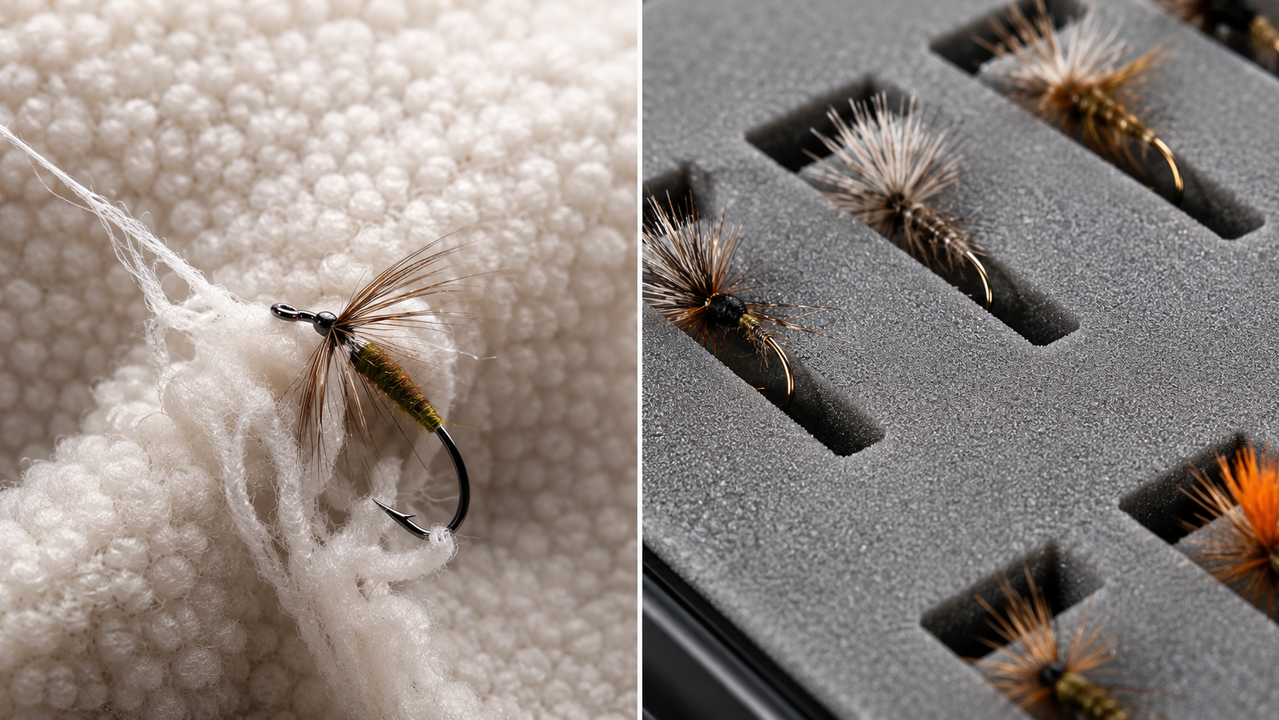
Looped fabric snagging on a fly hook (left) vs. precision-slotted foam protection (right) for custom fishing cases.
2. Why Minimalist AI Designs Often Cost More to Manufacture
Unit cost is driven primarily by manufacturing difficulty and defect rates—not just raw fabric price. AI frequently generates sleek, "seamless" curves or hidden zipper tracks that look simple on screen. In production, achieving those clean lines often requires multi-step thermoforming, manual hand-gluing, complex curved binding, or tight-tolerance jigs. Higher assembly complexity increases material waste and defect rates, making a minimalist-looking bag substantially more expensive than a structurally complex design built with standard industrial workflows.
📊 AI Concept Renders vs. Engineered OEM/ODM Specifications
Bridging the gap between an AI image and mass production requires converting visual guesses into measurable engineering parameters. The comparison below outlines how LeaderCases audits and upgrades AI-generated concepts before tooling begins:
| Evaluation Factor | Raw AI-Generated Concept | LeaderCases Production Engineering |
|---|---|---|
| Exterior Shell & Fabric | Unidentified textures; ignores abrasion, UV, or water resistance. | 1680D Nylon, eco-friendly PU/PVC, canvas, Oxford cloth, neoprene, or genuine leather with 75°–80° Shore Hardness EVA rated for Drop-Test protection. |
| Interior Protection | Aesthetic fabrics (e.g., looped fleece) that can snag, scratch, or crush gear. | Custom CNC Die-Cut EVA Foam or non-abrasive felt, satin, and soft linings matched to device geometry. |
| Weather & Dust Sealing | Illustrates impossible "invisible" zippers without structural waterproof seals. | Water-repellent coatings, sealed hardware, or hard-shell gasket structures tested up to IP67 Waterproof Rating where required. |
| Cost & Assembly Efficiency | Zero cost awareness; hidden seams cause high scrap and labor bottlenecks. | DFM (Design for Manufacturability) optimization with automated cutting and precision stitching lines to keep defect rates low. |
| Validation & MOQ | Digital pixels only; zero physical tolerance verification. | Sample Lead Time 5–10 Days; 200,000 pcs/month capacity; flexible launch at MOQ 200pcs (light custom) / 500pcs (bespoke mold). |
⚙️ Our OEM/ODM Workflow: From AI Concept to Mass Production
A structured engineering workflow turns rough AI visuals or sketches into repeatable, high-consistency factory production. At LeaderCases, every custom project moves through four clear stages before bulk shipment:
LeaderCases 4-Step End-to-End OEM/ODM Workflow:
01. Idea Input & Consultation: Share your AI concept render, rough sketch, or product dimensions along with target budget and usage environment—our team evaluates feasibility, material options, and accurate cost estimates upfront.
02. Precise 2D/3D Tech Pack & Pattern Engineering: Our engineers translate your concept into flat structural patterns, calculate seam allowances and EVA/foam tolerances, and plan logo branding (debossing, hot stamping, embroidery, silk screen, laser engraving, metal, or silicone badges).
03. Rapid Sampling (5–10 Days): We match raw materials, complete prototyping, and deliver a physical sample within 5–10 days so you can verify fitment, protection, and finish before mass production.
04. Strict Production (AQL 2.5 QC) & Global Logistics: Upon sample approval, our Guangdong facility (1,500+ sqm, 200,000 pcs/month capacity) executes automated cutting, precision assembly, multi-stage inline inspection under AQL 2.5 standards, retail packaging, and global/DDP shipping.
🤝 Turning AI Ideas into Real Products Through Transparent Engineering
Successful custom manufacturing relies on open, professional collaboration—not blind execution of a digital picture. As an old Chinese proverb aptly puts it: "Sharp tools make good work" (工欲善其事,必先利其器)—and when combined with sincere communication, any technical hurdle can be resolved.
The LeaderCases OEM/ODM Engineering Standard:
Established in 2009 and serving clients across North America, Europe, Asia, and the Middle East, LeaderCases stands in the buyer's shoes on every project. When you bring us an AI concept, we respect your creative vision while proactively flagging material incompatibilities, tooling lead times, and hidden assembly costs. By pairing friendly, transparent communication with physical sample validation, we ensure your final case protects your product and hits your target landed cost.
Ultimately, AI is a landmark tool of progress. When buyers leverage AI to express creative vision and factories apply engineering discipline to make those ideas safe, durable, and cost-effective, both sides win. How is AI reshaping product development or sourcing in your industry? Share your experiences with our team—we welcome the conversation.
❓ Frequently Asked Questions
Q: Can I send an AI-generated image to LeaderCases instead of a CAD file to start a custom case project?
A: Yes. You can send AI concept renders alongside your product dimensions, weight, and target budget. Our structural engineers will convert your visual concept recommend appropriate EVA hardness, fabrics, and foam inserts.
Q: Why does a simple-looking AI bag design sometimes cost more than a complex-looking case?
A: Manufacturing cost depends heavily on assembly difficulty, sewing jigs, and defect rates rather than fabric yardage alone. Seamless silhouettes or concealed closures generated by AI often require extra thermoforming steps and manual labor, which raises unit costs unless optimized for production.
Q: How fast can LeaderCases turn an AI concept into a physical prototype, and what is the MOQ?
A: Our sample lead time is 5–10 days for physical prototyping and fitment verification. We support low-risk market launches starting at an MOQ of 200 pcs for light customization and 500 pcs for full bespoke mold development.